Born in 1962, Stefan Sagmeister has become a world-renowned graphic designer and typographer through his fresh, timeless, and of-the-moment designs. Sagmeister is a Bregenz, Austria native who began his design career at the early age of 15 when he worked for “Alphorn,” a popular Austrian youth magazine. Only a few short years later, Sagmeister studied graphic design at Vienna’s University of Applied Arts. Due to his outstanding work, Sagmeister then received a Fulbright Scholarship to study at the Pratt Institute in New York. Finally, his formal schooling behind him, Sagmeister tried his luck in Hong Kong with advertising executive Leo Burnett’s Hong Kong Design Group in 1991, but he returned to New York after only two years. In New York Sagmeister teamed up with M&Co Design under Tibor Kalman, an influential American graphic designer of Hungarian descent. Unfortunately, as with when Sagmeister was in Hong Kong, his stay at M&Co Design was short-lived thanks to Kalman’s departure to be the editor-in-chief for Colors Magazine. In the same year (1993), Sagmeister established his own eponymous company, named Sagmeister, Inc. (Heller, 2009). The company’s website explains:
Sagmeister, Inc. is a graphic design company in New York City. We design all things printed, from posters, brochures, books and annual reports to identity systems, perfume packaging and CD covers. We love our jobs. (Sagmeister, Inc., 2010)
With this simple and unassuming statement, Sagmeister began making a name for himself.
Stefan Sagmeister’s philosophy on design is that “design should touch viewers’ hearts.” It is a simple yet powerful message, just as The Beatles wrote “All You Need is Love” and meant it. Sagmeister explains that too often these days, people see beautiful design all around them—design that is clean and visually pleasing, professionally designed posters and photographs—yet it all continues to leave the audience cold and without much emotion towards the piece. Sagmeister refers to it as fluff (Sagmeister Interview, 2007). The design looks great, but does it make you feel something deep down? Does it make you stare at it or continually return to it? Does it say something more than a superficial and easily forgotten message? Again, Sagmeister tries to design with viewers’ hearts in mind, not just their eyes.
In order to achieve and follow this philosophy, Sagmeister creates not only eye-catching designs, but also designs that are timeless and of the moment. He accomplishes this by pouring his own heart into the design and paying extreme attention to detail so that the viewer can find something new in the design every time they return to look upon it. Sagmeister’s designs often show threads of humor, but are always made with completely serious intent (Stefan Sagmeister—TED, 2004). Sagmeister’s design challenges viewers to think about the design and also about what it means in their own lives. His design is raw, original, handwritten, from heart to pen to paper with no intermediaries.
One testament to his philosophy on designing to create deeply felt emotion was when Sagmeister harmed his owned body for the sake of his craft by creating the AIGA Detroit poster. Without directly confronting the issue, Sagmeister poses a question to designers about the loss of art in the new digital design age where programs and computers produce art much quicker and without much thought. The dialogue for the poster is carved into Sagmeister’s naked torso (Sagmeister Interview, 2007). The image is thought provoking and subtly sarcastic. It shows the pain of design in a very literal sense and encourages designers to remember how to create from the soul (not just a computer) and to use that art to inspire. He truly touches the viewer’s heart.
Sagmeister does not restrict himself to a certain style, although he states that his “style” makes subtle appearances here and there (Sagmeister Interview, 2007). He also does not restrict his design to specifically styled projects. He creates posters, album art, packaging, typographic designs, etc. and accepts these projects as they come. One of his main philosophies on life is to do work that makes you happy. Another personal philosophy on working is to take one-year sabbaticals consistently. Every few years, Sagmeister retreats to a location outside of New York (often to Bali) to refresh himself, to experiment with design, and to remember why he does what he does. He does not take any work from clients during these specific years, no matter how tempting the project (he apparently turned down the opportunity to design for one of President Obama’s campaigns). Sagmeister believes that rest from client work is crucial in staying happy while maintaining a fresh outlook on design (Heller, 2009).
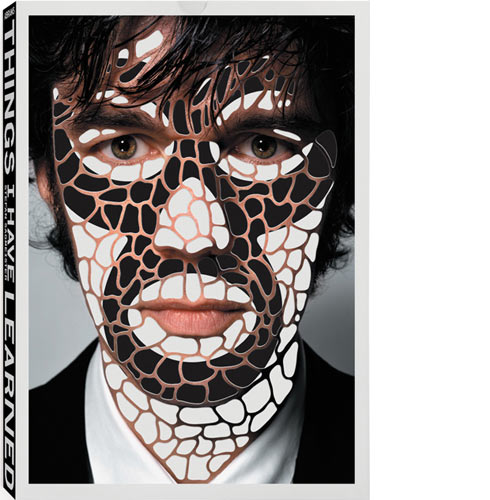
Along with his design philosophy, Sagmeister is not shy about his personal life philosophies. He wrote a life lessons book with 20 maxims titled, “Things I Have Learned in My Life So Far.” Some life lessons include:
1) Helping other people helps me.
2) Having guts always works out for me.
10) Money does not make me happy.
15) Worrying solves nothing.
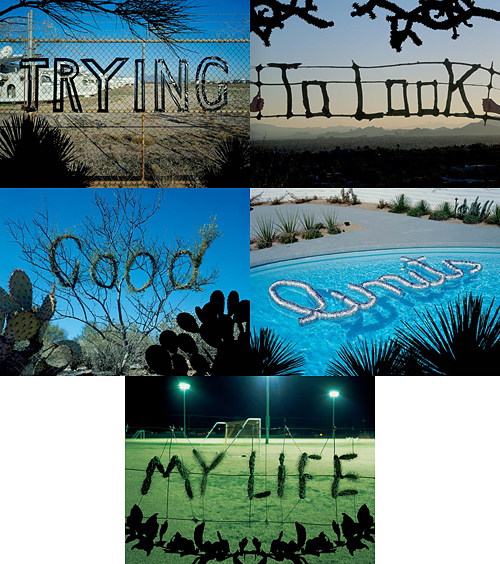
The maxims are taken from his diary entries he wrote in 2000, a sabbatical/experimental year. In the next few years, the life lessons turned into typographical design projects, photographing and filming the words from the lessons in different forms around different cities and then putting them together in different forms of media (Williams, 2008). Therefore, Sagmeister’s personal philosophies on life often coincide with his design philosophies.
Sagmeister first started grabbing consumer’s attention with his album art projects. Collaborating with Lou Reed and David Byrne (from “Talking Heads”) Sagmeister, garnered positive results and continued to do work for the “Rolling Stones” and “Aerosmith,” as well as several other artists. Sagmeister believes in working with kind-hearted artists whose music he truly enjoys. He has also received three Grammy awards for his album packaging and artwork. This includes work on Once in a Lifetime, a box set by Talking Heads, and the album Everything That Happens Will Happen Today by David Byrne and Brian Eno (Heller, 2009).
Among several interesting print fashion brochures and his album artworks, Sagmeister took on a unique project in “Unavailable,” a fragrance and soap line by Blue Q. The perfume was packaged in a book with the 15 Unavailable principles on the inside cover. The soap had “un” less embossed than “available” so that over time, the user would “become available” (Sagmeister, Inc., 2010).
It seems that Sagmeister has some sort of common thread in his designs in terms of designs that change over time. A few examples would include a billboard he create with paper that yellowed in the sun. His team prepped the paper in the sun and using stencils to block the light of the sun while the rest of the paper yellowed a bit. The billboard was hung up and as the day passed the stenciled letters appeared and then the yellowing took them over too so that they eventually blended into the rest of the paper. Another example is a book sleeve that had holes punched into so that over time the book cover underneath the sleeve changed color (TED Talks, 2004).
Of course, maybe Sagmeister’s most attention-grabbing, designer-defining piece was his own body on the AIGA Detroit poster. But lately, Sagmeister has found new work in his typographical works that take entries from his diaries and spread them around town in different fashions. His maxims have been made out of coat hangers, bamboo, inflatable monkeys, a computer graphical and motion censored spider web display, yellowed paper, building walls, steamed glass, and plenty more interesting objects (Sagmeister, Inc., 2010).
Sagmeister has also contributed political commentary through mobile displays about government spending, he has created a chameleon-like logo for Seed Media Group that changes according to what the logo is printed on and what that document’s purpose is, and he has created fully customizable Vilcek Award trophies. Sagmeister truly has no limit or restrained “style” to what he does. Just read his design monograph, “Made You Look” or life lessons book, “What I Have Learned in My Life So Far,” to understand why he truly loves the work he chooses to do (Sagmeister, Inc., 2010).
Stefan Sagmeister is his own person and his own designer. He takes challenges that he desires to take on and is truly happy because of it. He splashes humor and optimism in his extremely detailed works that require second looks and thoughtful insights. He makes statements about design and politics without ever picking a fight or attempting to start a commotion. He does not look for attention, but garners it through his work and is thereby extremely influential in the design world. Stefan Sagmeister is the epitome of a faithful and true designer.
(Cited Works and Sample Works are in the following two posts below.)