Monday, May 10, 2010

Stefan Sagmeister

Stefan Sagmeister

Born in 1962, Stefan Sagmeister has become a world-renowned graphic designer and typographer through his fresh, timeless, and of-the-moment designs. Sagmeister is a Bregenz, Austria native who began his design career at the early age of 15 when he worked for “Alphorn,” a popular Austrian youth magazine. Only a few short years later, Sagmeister studied graphic design at Vienna’s University of Applied Arts. Due to his outstanding work, Sagmeister then received a Fulbright Scholarship to study at the Pratt Institute in New York. Finally, his formal schooling behind him, Sagmeister tried his luck in Hong Kong with advertising executive Leo Burnett’s Hong Kong Design Group in 1991, but he returned to New York after only two years. In New York Sagmeister teamed up with M&Co Design under Tibor Kalman, an influential American graphic designer of Hungarian descent. Unfortunately, as with when Sagmeister was in Hong Kong, his stay at M&Co Design was short-lived thanks to Kalman’s departure to be the editor-in-chief for Colors Magazine. In the same year (1993), Sagmeister established his own eponymous company, named Sagmeister, Inc. (Heller, 2009). The company’s website explains:

Sagmeister, Inc. is a graphic design company in New York City. We design all things printed, from posters, brochures, books and annual reports to identity systems, perfume packaging and CD covers. We love our jobs. (Sagmeister, Inc., 2010)

With this simple and unassuming statement, Sagmeister began making a name for himself.

Stefan Sagmeister’s philosophy on design is that “design should touch viewers’ hearts.” It is a simple yet powerful message, just as The Beatles wrote “All You Need is Love” and meant it. Sagmeister explains that too often these days, people see beautiful design all around them—design that is clean and visually pleasing, professionally designed posters and photographs—yet it all continues to leave the audience cold and without much emotion towards the piece. Sagmeister refers to it as fluff (Sagmeister Interview, 2007). The design looks great, but does it make you feel something deep down? Does it make you stare at it or continually return to it? Does it say something more than a superficial and easily forgotten message? Again, Sagmeister tries to design with viewers’ hearts in mind, not just their eyes.

In order to achieve and follow this philosophy, Sagmeister creates not only eye-catching designs, but also designs that are timeless and of the moment. He accomplishes this by pouring his own heart into the design and paying extreme attention to detail so that the viewer can find something new in the design every time they return to look upon it. Sagmeister’s designs often show threads of humor, but are always made with completely serious intent (Stefan Sagmeister—TED, 2004). Sagmeister’s design challenges viewers to think about the design and also about what it means in their own lives. His design is raw, original, handwritten, from heart to pen to paper with no intermediaries.

One testament to his philosophy on designing to create deeply felt emotion was when Sagmeister harmed his owned body for the sake of his craft by creating the AIGA Detroit poster. Without directly confronting the issue, Sagmeister poses a question to designers about the loss of art in the new digital design age where programs and computers produce art much quicker and without much thought. The dialogue for the poster is carved into Sagmeister’s naked torso (Sagmeister Interview, 2007). The image is thought provoking and subtly sarcastic. It shows the pain of design in a very literal sense and encourages designers to remember how to create from the soul (not just a computer) and to use that art to inspire. He truly touches the viewer’s heart.

Sagmeister does not restrict himself to a certain style, although he states that his “style” makes subtle appearances here and there (Sagmeister Interview, 2007). He also does not restrict his design to specifically styled projects. He creates posters, album art, packaging, typographic designs, etc. and accepts these projects as they come. One of his main philosophies on life is to do work that makes you happy. Another personal philosophy on working is to take one-year sabbaticals consistently. Every few years, Sagmeister retreats to a location outside of New York (often to Bali) to refresh himself, to experiment with design, and to remember why he does what he does. He does not take any work from clients during these specific years, no matter how tempting the project (he apparently turned down the opportunity to design for one of President Obama’s campaigns). Sagmeister believes that rest from client work is crucial in staying happy while maintaining a fresh outlook on design (Heller, 2009).

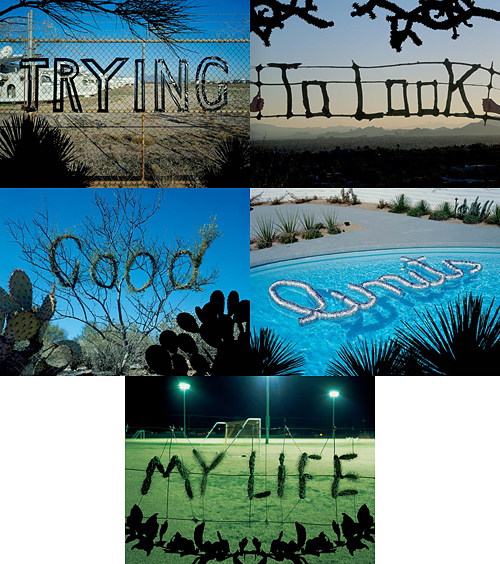
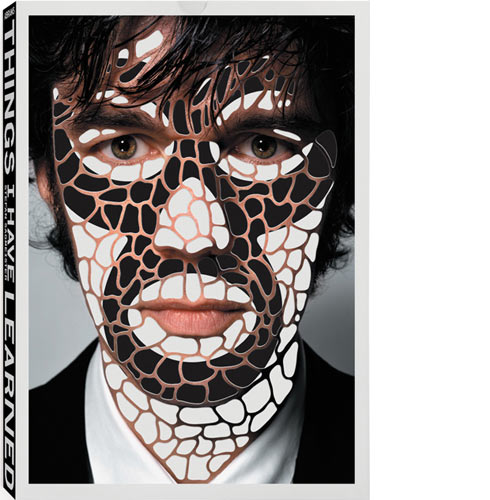
Along with his design philosophy, Sagmeister is not shy about his personal life philosophies. He wrote a life lessons book with 20 maxims titled, “Things I Have Learned in My Life So Far.” Some life lessons include:
1) Helping other people helps me.
2) Having guts always works out for me.
10) Money does not make me happy.
15) Worrying solves nothing.

The maxims are taken from his diary entries he wrote in 2000, a sabbatical/experimental year. In the next few years, the life lessons turned into typographical design projects, photographing and filming the words from the lessons in different forms around different cities and then putting them together in different forms of media (Williams, 2008). Therefore, Sagmeister’s personal philosophies on life often coincide with his design philosophies.

Sagmeister first started grabbing consumer’s attention with his album art projects. Collaborating with Lou Reed and David Byrne (from “Talking Heads”) Sagmeister, garnered positive results and continued to do work for the “Rolling Stones” and “Aerosmith,” as well as several other artists. Sagmeister believes in working with kind-hearted artists whose music he truly enjoys. He has also received three Grammy awards for his album packaging and artwork. This includes work on Once in a Lifetime, a box set by Talking Heads, and the album Everything That Happens Will Happen Today by David Byrne and Brian Eno (Heller, 2009).

Among several interesting print fashion brochures and his album artworks, Sagmeister took on a unique project in “Unavailable,” a fragrance and soap line by Blue Q. The perfume was packaged in a book with the 15 Unavailable principles on the inside cover. The soap had “un” less embossed than “available” so that over time, the user would “become available” (Sagmeister, Inc., 2010).

It seems that Sagmeister has some sort of common thread in his designs in terms of designs that change over time. A few examples would include a billboard he create with paper that yellowed in the sun. His team prepped the paper in the sun and using stencils to block the light of the sun while the rest of the paper yellowed a bit. The billboard was hung up and as the day passed the stenciled letters appeared and then the yellowing took them over too so that they eventually blended into the rest of the paper. Another example is a book sleeve that had holes punched into so that over time the book cover underneath the sleeve changed color (TED Talks, 2004).

Of course, maybe Sagmeister’s most attention-grabbing, designer-defining piece was his own body on the AIGA Detroit poster. But lately, Sagmeister has found new work in his typographical works that take entries from his diaries and spread them around town in different fashions. His maxims have been made out of coat hangers, bamboo, inflatable monkeys, a computer graphical and motion censored spider web display, yellowed paper, building walls, steamed glass, and plenty more interesting objects (Sagmeister, Inc., 2010).

Sagmeister has also contributed political commentary through mobile displays about government spending, he has created a chameleon-like logo for Seed Media Group that changes according to what the logo is printed on and what that document’s purpose is, and he has created fully customizable Vilcek Award trophies. Sagmeister truly has no limit or restrained “style” to what he does. Just read his design monograph, “Made You Look” or life lessons book, “What I Have Learned in My Life So Far,” to understand why he truly loves the work he chooses to do (Sagmeister, Inc., 2010).

Stefan Sagmeister is his own person and his own designer. He takes challenges that he desires to take on and is truly happy because of it. He splashes humor and optimism in his extremely detailed works that require second looks and thoughtful insights. He makes statements about design and politics without ever picking a fight or attempting to start a commotion. He does not look for attention, but garners it through his work and is thereby extremely influential in the design world. Stefan Sagmeister is the epitome of a faithful and true designer.

(Cited Works and Sample Works are in the following two posts below.)

Cited Works for "Stefan Sagmeister"

Cited Works

Heller, Steven. "Stefan Sagmeister." Printmag.com. 02/01/2009. Coverleaf. 4/30/2010. http://printmag.coverleaf.com/printmag/200902/?pg=36.

"Sagmeister, Inc." 4/30/2010. http://sagmeister.com/sagmeister.html.

"Stefan Sagmeister: Graphic designer." 2004. TED. 04/02/2010. http://www.ted.com/speakers/stefan_sagmeister.html.

"Stefan Sagmeister interview." 08/15/2007. Wallpaper. 04/02/2010.
http://www.wallpaper.com/art/stefan-sagmeister-interview/1661.

"TED.com Conference Talks." 2004, 2008, 2009. TED.com. [4/20/2010]. http://www.ted.com/speakers/stefan_sagmeister.html.

Williams, Eliza. "Things I Have Learned In My Life So Far." 02/05/2008. Creative Review. 4/20/2010. http://www.creativereview.co.uk/cr- blog/2008/february/things-i-have-learned-in-my-life-so-far.

Tuesday, May 4, 2010

Stefan Sagmeister Works

Stefan Sagmeister works including album artworks, posters, his famous AIGA Detroit poster, and a few pieces from this life lessons book, "Thing I Have Learned so Far."


60's and 70's have come back. The 80's? Please, not yet.


British radio company, Pure, has come out with a line of retro/vintage radios. I have noticed a strong comeback of simple and retro music devices lately (record players and vinyl... new ones, but designed like the old ones), and it seems Pure has caught on to the trend. Its simplicity in design! SO... now you can check out the "Evoke (portable), the Oasis (poolside) and the Siesta (bedside)" raidos! Click through for prices!

Monday, May 3, 2010

Cellphone and iPod Mouses?

Carnegie Mellon University researchers have made electronic devices into their own mouses. Using two optical sensors, the new device can attach on to cellphones and ipods with touch screens to perform the the functions a finger normally would have difficulty doing... highlighting, moving through screens, etc. It uses common technology so it would be cheap and easy to duplicate... many of these could be available in the near future! I would love to keep my fingers off my screen to not obstruct my view!

Check it out:


A 3D Mars for the people


Filmmaker, James Cameron, has approached NASA to include 3D cameras on the next rover going to Mars in 2011. The idea was originally scrapped in 2007 due to budgetary reasons, but James Cameron lobbied for the cameras to be developed and included because it would spark public interest. If this happens, the public could get more involved in space exploration, giving the many people who oppose giving so much money to it a reason to pay attention. I'd watch it.

Check out the camera. Then check out this review on Hubble 3D.

Ball Bot

Researchers at Tohoku Gakuin University (Japan) have created a robot that balanace and move on a basketball using three wheels. The bot can balance when pushed, it can carry glasses of water, and it can act as a wheelbarrow by itself or teamed up with two other robots. Cool, except, my question is... what is it good for? I'm sure that this is a great feat for scientists, but socially and for the world, what good does it do us? What will it eventually be a part of? Give us non-scientists a reason to care!


Pedestrian Power


Pedestrians in Toulouse, France are going to test out a new form of sustainable energy. Inspired by a dance club in Rotterdam, Netherlands, they will install absorbing tiles in the city square that when stepped on generates a motor..... they will hopefully be able to power some of the streetlights! If the skinny french men and women are not heavy enough to generate enough noticeable power, they will try the tiles out in the fatter city of Huntington, West Virginia. Go America.

But still, great idea.

Eric Austin one-ups the BeetleCam!

So what happens when the BeetleCam can't get over the toughest terrain? What happens when being stuck on the ground (and getting mauled by lions) gets old, BeetleCam? Well, Eric Austin, has one-upped the BeetleCam with his Helicam. Essentially, a toy helicopter houses a Canon DSLR that shoots superb HD video. With an electrical motor, the Helicam is quiet and does not vibrate like a gas motor might. If you know how to fly it, you can get amazing aerial shots with out being close to the object. Hover over water and fly above trees. Just don't crash it!

I want one. Bad.


Aerial video with a Canon 5D , 7D helivideo.com from Eric AUSTIN on Vimeo.

BeetleCam


Brothers Will and Matthew Burrard-Lucas ingeniously created a mobile ground device that can house high quality cameras. Why is this important? Because when photographing dangerous animals up close, there is an extreme risk of being mauled. So! The brothers built a camouflaged mini remote controlled car with over sized wheels and an over sized engine built to endure tough terrain. They have successfully photographed Elephants, African Buffalos, and a Lioness (who ended up mauling the BeetleCam itself, but luckily the memory card was salvageable!). I guess thats what it was made for! safety!

The coolest, most effective billboard I've seen

In the Netherlands, it is common for public service employees to be hassled and attacked by other citizens. I'm not entirely sure why, but apparently, its big issue. The Dutch government, therefore, created its on public service announcement billboard and essentially shames all who stand by and watch these events happen. Using a prerecorded, bluescreen-ed event in one corner of the billboard and mirror image of the street below the billboard that shows people watching the billboard and the event that takes place on it, passerbys are directly confronted for their inaction. It gives 4 tips for when they encounter a real event in the future... essentially, do something about it to help your public service employees! What a cool and interesting way to truly get people's attention on an extremely important matter!

check it:


First offshore Wind Farm


The Cape Wind project has finally been approved for placement below Cape Cod. In what may be the first step in a making more wind farms down the coast, the project will be like the equivalent of taking 175,000 cars off the road. It is clean, reusable, and efficient. Downfalls? They are poles sticking out of the ocean creating bad views and unpassable waters. It is good for our environment but at the same time is marring the beauty of our environment. If more Wind Farms get approved... America will be guarded along the coast with turbines. Hmm... gotta weigh the positives vs. the negatives on this one!

Compressed air fire starters


This is pretty sweet. It makes sense, but I guess I never realized that the quick compression of air (or many gases) can creat fire caused by the extremely heating of the gas. I also didn't know that fire pistons are already used and have been used for quite some time... they are often used for survival or just to start campfires without flint or a gas lighter. No more rubbing sticks or using lenses and the sun to start your fire! sweet. $45-$65.


Gray Matter: The Fire Piston from PopSci.com on Vimeo.

Southwest progresses!


Southwest is one of my favorite airlines... it is a discount airline that offers all the amenities... amazing! Now, the airline takes another step in the right direction with GPS-Guided landing. Instead of dropping the plane in altitude via staircase-like steps for a landing (by communication from pilot to ground control), the GPS-guided landing will create a smooth, efficient, gas-saving (money-saving), and time-saving descent. With $175 million invested, Southwest hopes to make back that money with the money and time it will save when landing its planes! Yet, they insist that the pilot is still the one landing the plane, putting ease on passengers mind about technology landing the plane (without situational knowledge)... this isn't your Lexus parallel park assist. The pilots are still in control!

IBM's Aquasar Supercomputer


IBM has created a cooling system for its supercomputer processors that not only cools the data chips but uses the heat waste from the chips to help heat buildings. Talk about instant recycling! The water is cooled water is pumped through processors and the heated water that exits the processors is pumped through the floors of buildings and right now, dormitories! As the development gets cheaper, this process may soon be used as sellable energy.

A Beta version is already being used in Zurich!

Authentic R/C car


For $500 you can get yourself your very own car... remote controlled car, that is. Losi's 1/10 TEN-T TRUGGY RTR is a racecar that has its very own engine that runs on actual fuel.... as if gas prices weren't high enough, now you have to buy gas for your toy to run on for 10 minutes... and use a squeeze bottle to put it in! Using an electric starter and a glow plug acting as a spark plug, this R/C car is more real than ever.

I feel, however, that I would rather spend $500 dollars on a used car that I can sit in, rather than one I can break by stepping on it?

Humans: Gods of Weather?


This is kind of absurd. I didn't know that cloud seeding was already being practiced (the ability to manipulate precipitation using silver iodide crystals)... thanks, China. And now lasers are being developed to actually create rainfall. I won't try to explain it myself, so here is popular science explaining it:

"The concept works because laser pulses strip electrons from atoms in the air and promote formation of hydroxyl radicals. Those in turn make sulfur and nitrogen dioxides into particles which can form the basis for water droplets -- not unlike how current cloud seeding methods use silver iodide crystals as the "seeds" for water droplets."

But honestly, its frightening to think about how technology has given humans the ability to make certain weather... I just don't see this having positive repercussions... socially and environmentally.

Sunday, May 2, 2010

super small STORAGE.


NC State researchers have developed nanodots. These dots are small magnetic dots that have the ability to store a single bit of data each. With so many dots fitting into such a small area, a one square inch space can store up to billions of pages of data. If the research continues to go right, we may soon have whole libraries stored on hand held devices. It will be a breakthrough in storage technology! Now what to do with all that storage space? I definitely don't have enough music to fill that up, let alone 80 GBs on my ipod.

Portable Urine Battery


A South Korean group created Metalcell, a battery with militaries in mind. When a soldier relies on electronics in battle, sometimes those electronics run out of power at the worst times. With the new battery, soldiers only need to add saltwater to the battery in order to charge their electronics for up to 4 hours. If they are low on saltwater, urine will do the trick... something that is always hand! Similar to Baghdad batteries, these batteries are innovation at its best!

Solar Powered Bags!


It turns out that solar panels are becoming much lighter and much less expensive. This new bag features a panel sewn into the design so that one may charge a cellphone or ipod or any other device in 6-8 hours inside or outside. No carbon footprint, clean, easy, perfect! The price tag is at $200 (Solar Bag with G24 DSSC) but expect it to drop in the near future, especially when this one is made by Tonino Lamborghini.

Why wouldn't this catch on???


After learning about Liquid Galaxy by Google, finding an article on a proposed "Living Earth Simulator" blew my mind. After $1.3 billion+ in funding, the brainchild of Dirk Helbing could become reality by year 2022. The Living Earth Simulator would take not only massive amounts of information from the Earth and its environments but also from humans themselves to create a sim-like world where the future (financially, disease, weather) could be relatively accurately simulated... much like the weather is predicted today. How insane would that be? I would be interested to see how the world's inhabitants would react to such a God-like project!

Liquid Galaxy

Google's Google Earth was put to shame in an immersive world tour by its on predecessor, Liquid Galaxy. Liquid Galaxy as demoed by Jason Holt (researcher) on 8 linux machines with a 6 point axis view. You fly into 3D images of the earth's environment with a touch of the mouse or a spoken command. Fly around the world, fly to the moon, and fly to mars. As a traveler, this is entirely amazing to me. To view a map of the world (and even underneath the ocean) is like previewing your next world travel... or maybe it helps in deciding on where to go next!


Evan Roth

Evan Roth is quite the artist. Working through a studio via Eyebeam in New York City, Roth has made name for himself by means of popular culture research and design. A few works that stuck out to me in his presentation at Hofstra were his “L.A.S.E.R. Tag” project and his graffiti analysis project. Both do with defacing public structures, but they also both show the beautiful art of graffiti artists. L.A.S.E.R. Tag involves a projector that traces a light source held by an artist so that the artist can scribe graffiti on enormous scales (sides of buildings, the coliseum in Rome, etc.) with actually damaging property. At nighttime, the graffiti is so bright and big, people form miles away can experience the tag. Then, it can be erased instantly to give clean canvas for the next tag. The graffiti analysis project was interesting because it really breaks down the style and technique of famous taggers and thereby it creates the first ever intricate database of the art.

In general, Even Roth is about freedom of speech and freedom from censorship. He is an open source promoter and has worked with names like Jay-Z. His style and philosophy has garnered himself a great amount of attention in the design world.

As a speaker, Roth is very conversational. He was very intimate and interactive with his presentation, and his slideshow involved images, videos, and more. (I’m glad he stood up to speak, for it would have been difficult to hear him across the room.) Overall, he made a truly engaging presentation.